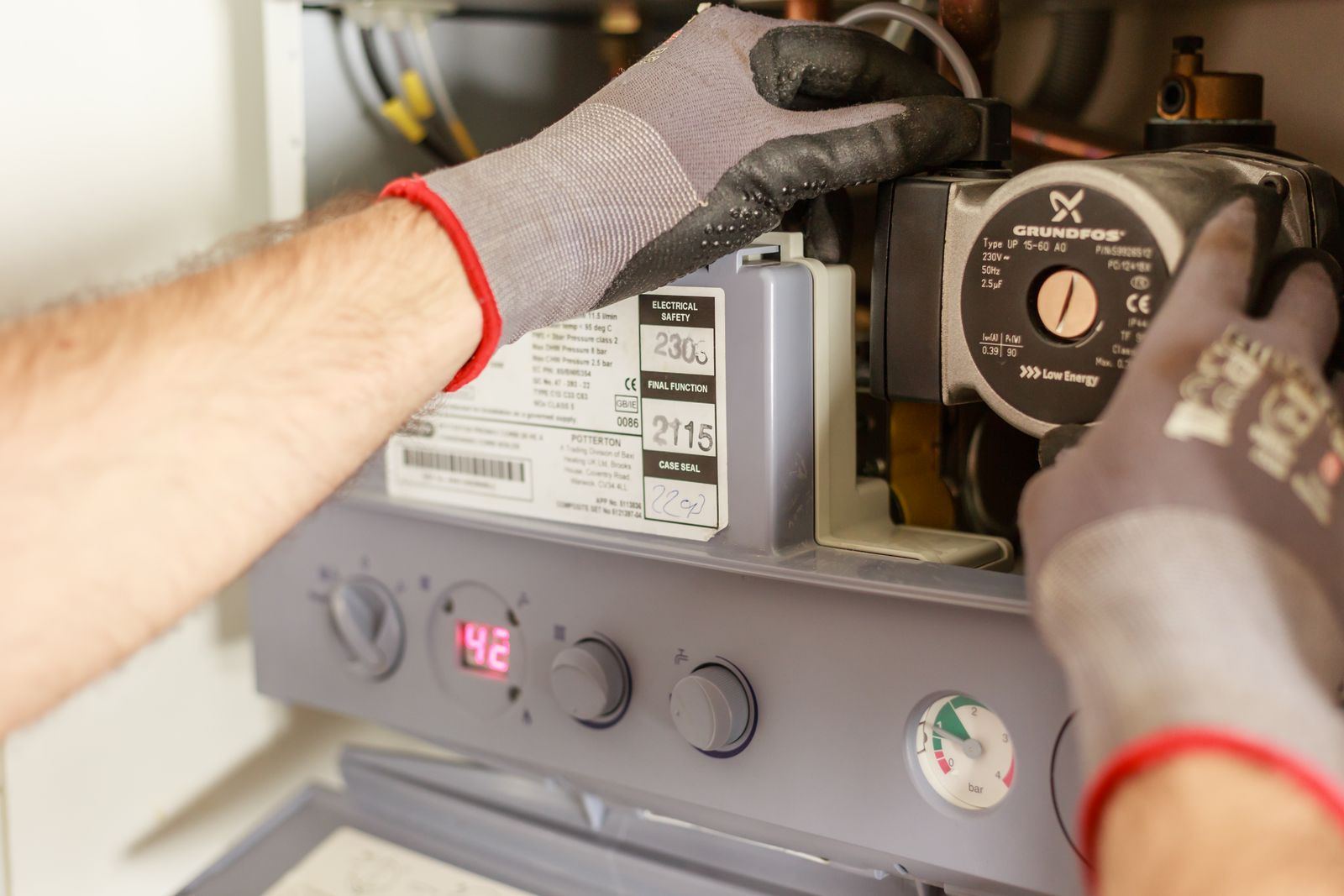
Tankless units are sophisticated machines, and that is both their strength and their weak spot. Instead of keeping forty or fifty gallons hot around the clock, a tankless heater springs into action only when water starts moving: a flow sensor detects demand, the control board fires the burner or elements, and water is heated on its way through the heat exchanger. Every step is watched by a sensor, and if any reading drifts outside its expected range, the board shuts the heater off and displays a code. For Lakewood, OH homeowners, that usually traces back to a short list of causes: scale building up inside the heat exchanger, a sticking or dirty flow sensor, an ignition problem at the igniter or flame rod, or a venting or gas supply issue the unit reads as unsafe.
Our approach to tankless repair is simple: measure first, replace second. When we arrive at your Lakewood home, we record the active code and the unit's fault history, then work through the systems behind it. Flow sensors are checked with water running to confirm they report demand correctly. Flame rods and igniters are tested electrically. Gas pressure is read at the inlet with the burner at maximum, because a line that holds steady at idle can sag badly under full load. The vent and air intake are inspected end to end, and the heat exchanger is judged by the temperature rise it achieves at a known flow. Only then do we recommend a fix, and we can show you exactly why.
We work on tankless heaters from Rinnai, Navien, Noritz, Rheem, Takagi, and the other major brands, gas-fired and electric alike. The fix depends on the diagnosis: a full descaling flush through the isolation valves when scale is choking the heat exchanger, a new flow sensor when the unit no longer notices a faucet opening, a fresh igniter or cleaned flame rod when ignition keeps failing, or a vent correction when the unit trips on combustion air. Sometimes the answer is bigger. A gas line undersized for the unit's full firing rate has to be upsized, and a heat exchanger cracked by years of scale may make replacement the smarter call on an older unit. We lay out every option honestly before any money is spent. Call (216) 247-2721 to schedule tankless repair.
Our most requested service is Water Heater Repair in Lakewood. Either is a good place to start.
Symptoms That Mean It's Time to Call
Water heaters usually give plenty of warning before they fail, as long as you know what to look and listen for. If any of the following sound familiar, it's worth having the unit checked:
- Cold slugs in the middle of hot water that last longer than before
- Unusual noises from the cabinet, like a whine, a roar, or a rattle
- Hot water that fluctuates even though nobody touched the faucet
- Water dripping from the cabinet or the condensate line
- No hot water at a low-flow faucet even though the shower works fine
- Repeated ignition attempts, then a shutdown
- Temperature dropping sharply when a second shower or the dishwasher starts
- A fault code on the front panel and no hot water
Small Symptoms, Big Consequences
Left alone, even minor symptoms like rumbling or temperatures that swing from hot to warm tend to mean the heater is working its way toward a breakdown. A quick call to (216) 247-2721 gets a technician out to check it before it becomes an emergency.
No Hot Water? We Can Help.
Call Lakewood Water Heater for fast, reliable service.
Call (216) 247-2721 TodayYour Tankless Water Heater Repair Questions Answered
Why Professional Tankless Water Heater Repair Matters
There are two reasons tankless repair belongs with a professional: the diagnosis is tricky and the hazards are real. On the diagnostic side, an ignition code might mean a worn igniter, a dirty flame rod, low gas pressure, or a blocked intake, and replacing parts until the code clears adds up fast. On the safety side, a gas unit burns fuel at a very high rate and vents exhaust that contains carbon monoxide, while an electric unit can pull more than 100 amps through multiple 240-volt breakers. Errors with either type can be serious.
A trained technician with the right instruments gets to the answer faster. Ours read the fault history, measure flame signal and igniter resistance, test flow sensor output, and check gas pressure under full load with a manometer, which is the only reliable way to catch a gas line that holds pressure at idle but sags when the burner ramps up. Descaling is done with a circulating pump and the proper solution, followed by a thorough rinse. Just as important, you get an honest opinion: if the heat exchanger is damaged on an older unit, we will say so before you spend money on a repair.
From Your Call to Hot Water
We work through a clear, repeatable process so you always know what's happening and what it will cost. Here's what you can expect when you choose Lakewood Water Heater:
Diagnose the Error Code
We pull the active error code and the stored fault history, then test the parts behind it: flow sensor, igniter, flame rod, gas pressure, and venting. That way the repair targets the actual cause, not just the code.
Plain Findings & Firm Quote
No surprises. We walk you through the cause and the fix and give you the price up front. If the real problem is an undersized gas line or a worn-out heat exchanger, we tell you before anything is spent.
Repair & Descaling
We carry the parts that fail most on tankless units, so flow sensors, igniters, flame rods, and thermistors are usually replaced on the spot, and descaling is done in roughly an hour.
Verified Temperature Rise
We run hot water at several flow rates, confirm the unit fires cleanly and holds its setpoint, and check gas pressure at full fire before we leave.
Want a Professional Opinion?
Our technicians can assess your water heater and recommend the option that actually makes sense.
Tap to Call (216) 247-2721How to Prevent Water Heater Problems
Routine maintenance is almost always cheaper and easier than an early replacement. Start with these practical measures our team relies on:
- If scale comes back quickly, add a softener or a scale-prevention cartridge on the cold inlet
- Treat a code that returns after a reset as a symptom worth diagnosing, not ignoring
- Tell us before adding a gas appliance, so the gas line can be checked for the extra load
- Leave the power on in cold weather, since freeze protection only runs when the unit has electricity
- Keep the vent termination and air intake clear of leaves, nests, snow, and lint
- Flush scale out of the heat exchanger annually, and sooner in hard water
- Check the inlet filter screen periodically, since a clogged one starves the unit of flow
Comparing DIY and Professional Work
Some simple checks are fine to do yourself, but most water heater repairs benefit from professional tools, training, and experience. A side-by-side look:
| Consideration | DIY Attempt | Professional Service |
|---|---|---|
| Diagnosis | Look up the code and replace a guess | Each suspect part tested with a meter |
| Scale Removal | Partial flush that leaves scale behind | Proper solution, pump, and flush time |
| Combustion Safety | Gas pressure and vent joints unchecked | Manometer test at full fire, vent inspected |
| Electrical Work | Live wiring inside the cabinet | Circuits and board checked with proper tools |
| Replacement Parts | Generic parts that may not fit the model | Model-matched parts, often on the truck |
| Result | Temporary fix at best | Unit tested at low and high flow |
Get Tankless Water Heater Repair Help Today
Get your hot water back before a small fault turns into a flooded floor. Lakewood Water Heater is ready to respond fast.
Call (216) 247-2721 NowTankless Water Heater Repair Near Lakewood
Our service area reaches well past the city limits. Choose your community for local details.